Frank Chang The Mesh
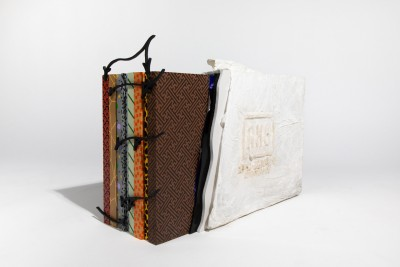
In the studio, I take on the perspective of an “archaeologist of the present” in order to reflect on the climate crisis. Otherwise, the stakes feel too high and making art feels futile and insignificant compared to the magnitude of the problem. I collect fragments of climate news, bureaucratic documents, and mass media imagery, looking for linkages that are unexpectedly resonant. I am searching for things under the surface, inexplicable connections that are strangely well suited to expressing the feeling of the present, with all its contradictions, anxieties, and possibilities.
This exhibition combines new and recent climate-related work. The title is inspired by philosopher Timothy Morton’s metaphor of the mesh. Morton uses the mesh to refer to the ecological interconnectedness of all things, both living and non-living. The mesh, according to Morton, allows us to imagine things normally thought to be contradictory. It is both foreground and background, hard and delicate. It is both too large and infinitesimally small. The mesh is the perfect metaphor for thinking about climate because “[e]ach point of the mesh is both the centre and edge of a system of points, so there is no absolute centre or edge.”[1] The mesh also perfectly encapsulates my working process, in which each fragment leads to another; I see what’s in front of me as both the beginning and end of the process.
Hyperbatteries is a series of sculptures that reconfigure the clean and rational aesthetics of various “green” battery technologies as dense assemblages of entangled materials, histories, and ideas. I began with the definition of batteries as connected energies, then followed threads ranging from the German Romanticism of early battery pioneers to Qing Dynasty symbolism and spirituality. Of course, replacing fossil fuels with renewable energy is crucial in helping to mitigate climate change. But batteries are too often depicted as the “solution” to climate change, with little regard for how they are produced or where their minerals come from. Indeed, as political scientist Thea Riofrancos points out, “…the promise of zero emissions sits alongside the reality of fossil fuel extraction and combustion, renewable energy deployment, and mining to outfit carbon-free capitalism.”[2]
Other works in the exhibition employ a variety of archaeologically inspired motifs and techniques, especially paper squeeze casting. Paper squeeze, or paper molding, was an archaeological technique developed by Alfred Maudslay in the late 19th century in which layers of wet paper were pressed onto Mayan monuments to create replicas that could later be cast in plaster. Maudslay used this technique to reach remote sites in Guatemala that would have been inaccessible to teams carrying tons of plaster-casting supplies. Incidentally, Maudslay began his archaeological work at the same time widespread global temperature recordings began. My paper sculptures are copies of copies, created by first making a “sacrificial sculpture,” which is then paper-molded. When completed, the original is thrown out, leaving the paper cast as the work. By displaying the cast as the artwork, I want to highlight its indeterminacy. The sacrificial sculpture can be thought of as both absent and present, like an impression, thought, or memory. The surface of these sculptures is fragile yet resilient and is skin-like, which reminds me of the solidity and impermanence of ourselves, our past, and our imagined futures.
FRANK CHANG (b. 1979, New York) is a multi-disciplinary artist who employs and re-frames ordinary or familiar visual forms in order to examine the entangled and complex interrelationships between climate, social, and cultural issues. Chang's work spans a variety of mediums, including works on paper, sculpture, installation, and performance, but each body of work is based upon a consistent methodology in which recognizable forms — from the vernacular to the historical — act as springboards for deeper investigations into these issues.
His work has been exhibited at Gallery Ondo (Seoul, South Korea), Gallery G (Hiroshima, Japan), Wells College (Aurora, NY), Ithaca College, Ortega y Gasset Projects (Brooklyn, NY), Bushel (Delhi, NY), Dartmouth College, the Torrance Art Museum, Museum of Jurassic Technology, LA Design Center, Woodbury University, and Virginia Commonwealth University, among others. He has also installed site-specific works on Governors Island, High Desert Test Sites (Wonder Valley, CA) and alongside a stream in South Windham, VT.He was formerly co-director of Monte Vista Projects in Los Angeles, and he was a contributor to the book Dispatches and Directions: On Artist-Run Organizations in Los Angeles and to the journal MATERIAL. He received his BA from Dartmouth College and his MFA from the California Institute of the Arts. He is a Lecturer in the Department of Art & Design at Binghamton University.
[1] Timothy Morton, The Ecological Thought, (Harvard University Press, 2010), 29.[2] Thea Riofrancos, Extraction: The Frontiers of Green Capitalism, (W. W. Norton & Company, 2025), 205.